
20 December 2025 Admin
Turkey’s hub gambit under stress: nuclear bets, gas hedging and contested corridors
1 - 7 December 2025
Turkey’s energy policy is no longer just a story of pipelines and transit fees. Over the past days, Ankara has stitched together a series of moves that show what a full-spectrum “energy–industrial hub” strategy looks like in practice: testing next-generation nuclear technology, hedging between Russian pipeline gas and U.S. LNG, using post-war Syria as a downstream market, and anchoring itself inside new Turkic and Gulf-linked power corridors. Together, these steps push Turkey deeper into the centre of Eurasian energy politics – but also expose it to every shock running through that system.
The most striking signal is Turkey’s quiet courtship of Bill Gates–backed TerraPower. Ankara has confirmed it is in talks to introduce small modular reactors (SMRs) as part of a long-term nuclear build-out that would reach at least 5,000 MW of SMR capacity by 2050.  This is not just about kilowatt-hours. SMRs promise a technology narrative – “clean, flexible, exportable nuclear” – that Turkey can sell to partners from the Balkans to the Gulf, while reducing long-term dependence on any single supplier such as Rosatom at Akkuyu. If the talks move from concept to contracts, SMRs would lock nuclear firmly into Turkey’s energy mix and open a new front for industrial cooperation, from fuel services to component manufacturing.
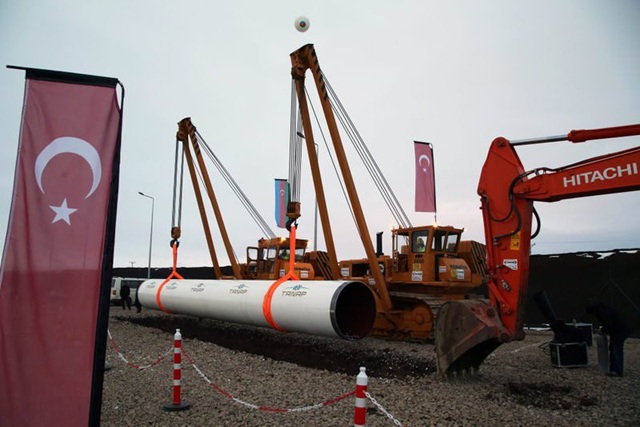
At the same time, Ankara is trying to rewrite the terms of its gas dependence. On one flank, state company BOTAŞ has extended two contracts with Gazprom – covering some 21–22 bcm per year via TurkStream and Blue Stream – for only one additional year. Turkish officials are explicit: the short horizon is meant to give Gazprom “a year to think about prices” at a moment when Turkey has become Russia’s second-largest gas customer after China, but Moscow’s leverage over Europe has collapsed.  On the other flank, Energy Minister Alparslan Bayraktar is negotiating stakes in U.S. gas projects with firms like Chevron and ExxonMobil, aiming to secure long-term LNG volumes at source and strengthen a supply chain that already feeds Turkey’s growing portfolio of regasification terminals.
That hedging strategy is reinforced by fresh LNG contracts. BOTAŞ has just signed twin 10-year deals with Germany’s SEFE and Italy’s Eni, starting in 2028 and covering a combined 11 bcm of gas-equivalent deliveries over ten winters.  These volumes will not displace Russian pipeline gas overnight, but they tilt the bargaining table. If Turkey can play Gazprom, U.S. suppliers and European traders against each other, it can push for lower import prices and more flexible terms – benefits it may then monetise through its own re-export ambitions towards Southeast Europe.
Turkey’s hub project is not confined to its own borders. One year after the fall of Bashar al-Assad, Turkish companies have raced into Syria and secured over $11 billion in reconstruction contracts, with a heavy concentration in power generation, grid rehabilitation and airports.  Plans include several gigawatts of new gas-fired and solar capacity and a pipeline from Kilis towards Aleppo and further south, effectively re-wiring Syria’s energy arteries northward. In parallel, Ankara is deepening energy ties with Pakistan through hydrocarbon exploration agreements and with Central Asian partners via the Organization of Turkic States (OTS), which is now actively promoting a “Green Energy Corridor” across Azerbaijan–Georgia–Turkey–Bulgaria and a planned Black Sea subsea cable to carry Central Asian renewables into Europe.
These outward moves sit alongside a new wave of investment into Turkey itself. Abu Dhabi’s Masdar is in the final stages of a US$1 billion deal for a 1.1 GW solar-plus-storage complex in central Anatolia – a flagship that aligns perfectly with Ankara’s target to boost installed renewables from 30 GW today to 120 GW by 2035 and positions Turkey as a large testbed for utility-scale storage in the wider region.  Meanwhile, European industrial groups such as Titan are expanding in Turkey with an explicit twin focus on cement and green energy markets, treating the country as a production and export base for decarbonised materials as much as a domestic market. And in the Gulf, deals like the new ACWA Power–Bapco Energies joint development agreement in Bahrain show that energy integration inside the GCC is picking up pace, offering Turkey both competition and potential partners in future cross-regional power and hydrogen schemes.
Politically, all of this is happening on a very narrow ridge. In Budapest, Viktor Orbán now openly describes Turkey as the guarantor of the transport route for Russian energy carriers to Hungary, after securing a U.S. waiver that shields TurkStream-related transactions from sanctions for at least a year.  Hungary’s parallel deals for Azeri gas and Greek corridor capacity underline a broader trend: Central and Southeast European states are trying to diversify away from Russia through Turkey, not around it. At the same time, Washington is reinforcing Greece and Cyprus as a Euro-Atlantic gas and LNG pivot in the Eastern Mediterranean, backing projects that deliberately route molecules and cables via Greek territory and interconnectors rather than Turkish ones. 
This split personality of the regional map – Turkey as indispensable bridge for some, rival hub for others – is particularly visible in the Eastern Mediterranean and Syria. Cairo’s maritime understandings with Khalifa Haftar on East Med boundaries are moving ahead in ways that may collide with Ankara’s own EEZ claims. Cyprus, heading into 2026 with a rapidly expanding but storage-poor solar fleet and unmonetised offshore gas discoveries, is betting heavily on the EuroAsia / Great Sea Interconnector to bind itself to Israel and Greece and lock in an EU-anchored electricity regime.  For Turkey, these are not just technical projects; they are tools for either constraining or bypassing its hub ambitions.
Economically, the stakes are high. If Ankara can sustain this balancing act – leveraging its geography to arbitrage between Russian, American, Azeri and Gulf suppliers, while using reconstruction and green corridors to open new markets – the payoff is significant. Lower import prices, more predictable supply and export revenues from re-sales and services could help stabilise a fragile macroeconomic picture and ease pressure on household energy bills across Turkey and parts of the Balkans and Levant. If it fails, however, the country risks being squeezed between harder Western sanctions, volatile Russian pricing and investor doubts about regulatory and political risk – with higher war-risk premiums in the Black Sea and Eastern Med quickly feeding into tariffs and subsidies from Athens to Amman.
For the wider MENA region, Turkey’s current moves are a reminder that “energy transition” is not a neat technocratic process but a contested political goals. Nuclear choices, LNG contracts, the routing of one pipeline or cable through one country rather than another – these are decisions about alliances, rents and social contracts as much as carbon. Ankara is betting that by becoming the place where these choices intersect, it can move from being a corridor used by others to a hub that shapes the rules. Whether that bet pays off will depend as much on the region’s conflicts and the mood in Brussels and Washington as on megawatts or bcm – but the direction of travel is now unmistakable.