24 April 2026 Admin
Nobody schedules a meeting to fall in love with a country. It happens through a television series watched at midnight, a recipe passed between neighbours, a scholarship that turns a stranger into a colleague. By the time it happens, it has already worked. That is the logic of cultural diplomacy, and it is one of the most misread tools in foreign policy.
It gets called soft because it moves quietly. But quiet is not weak. Quiet is what gets through when the louder channels have shut down.
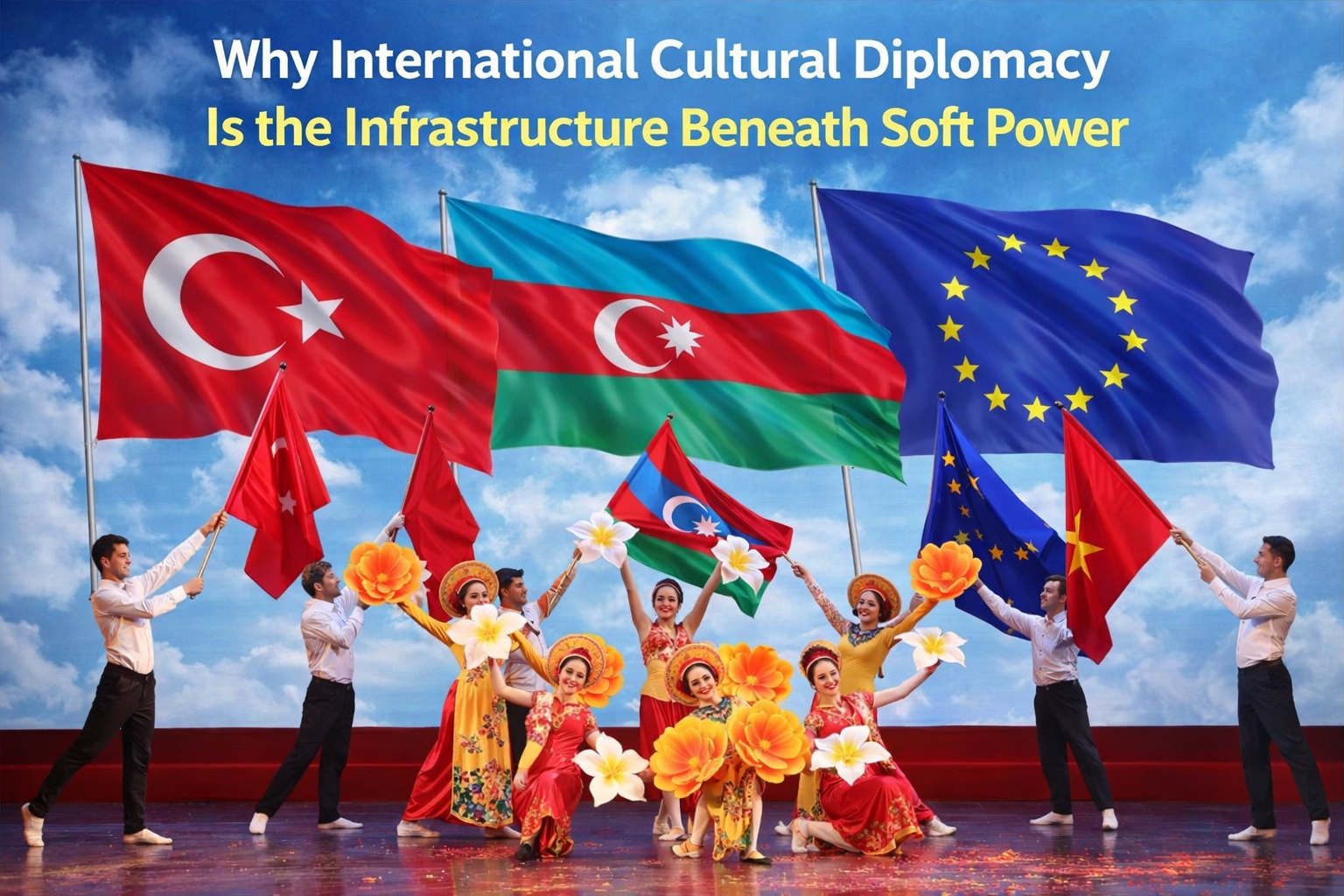
This is the argument Mena Centra makes, not as a theoretical exercise, but as the basis for practical work. International cultural diplomacy is central to how the MENA region builds its long-term standing in the world. The region has cultural weight. What it needs now are the institutions and systems to put that weight to sustained use.
Strip away the jargon, and the definition is simple: cultural diplomacy uses culture, language, art, heritage, education, and shared experience to build trust across borders. Not to win arguments. To make arguments less necessary.
Formal diplomacy is elite-to-elite. It operates through summits, signatories, and carefully managed statements. Cultural diplomacy is different. It is people-to-people: students, filmmakers, musicians, chefs, researchers, cities, neighbourhoods. It does not wait for a minister to permit it to travel.
This is why a serious cultural diplomacy program outlasts the political weather. Flights get cancelled. Embassies get downgraded. Summits collapse. But language students keep studying, exchange alumni keep corresponding, and co-productions keep airing. The relationship continues at a level that official diplomacy cannot easily reach or easily sever.
Ask anyone whether the Arab world has culture, and the question answers itself. The civilisational record here is not thin; it is overwhelming. Languages that shaped mathematics and philosophy. Architectural traditions that still draw visitors from across the world. Music, poetry, cuisine, and oral heritage of an extraordinary range. The question was never about presence. It has always been about the pipeline.
The Gulf has moved furthest in building that pipeline. International cultural diplomacy in the Gulf is not a programme run from a ministry's back office. It is national infrastructure: museums built as global landmarks, heritage sites developed as platforms, biennials and festivals funded to attract international audiences. Culture here sits inside the same strategic framework as trade and investment. It is measured, resourced, and taken seriously.
The criticism that this approach amounts to branding is fair, partly. But branding is nothing. Visibility shapes how a country is treated, invested in, and engaged with. The Gulf understood that earlier than most. Elsewhere in the Arab world, the cultural asset base is equally strong but differently expressed.
The bookshops and music scenes of Beirut, the medinas of Morocco and Tunisia, the living literary culture of Cairo, and the creative communities of Amman are not manufactured. They have roots. They carry credibility that staged destinations often cannot replicate. When cultural diplomacy flows from these environments, it reads as genuine. That is a different kind of asset, and a powerful one.
The gap across much of MENA is not cultural. It is institutional. A cultural diplomacy program is not a gala dinner or a national pavilion. It is a residency that runs for five years, a translation fund that operates annually, a joint degree that produces two hundred graduates, and a co-production that premieres in three countries. The difference between influence and impression is repetition. The region still leans too heavily on the impression.
Mena Centra works at the intersection of policy, practice, and partnership across the MENA region, Turkey, and Cyprus. Our engagement with cultural diplomacy is not academic. It is operational.
We work with governments and cultural institutions to develop long-term frameworks for engagement, programmes that are designed to outlast political cycles, ministerial rotations, and budget fluctuations. We connect regional practitioners with global networks of expertise, support the mapping of cultural partnership models, and facilitate dialogue between the people who design these programmes and the people who fund them.
We also engage with the dimensions of cultural diplomacy program work that rarely appear in strategy documents: heritage protection in conflict zones, cultural memory under threat, and identity preservation for displaced communities. In parts of the Levant and beyond, culture is not a diplomatic tool; it is a survival mechanism.
The institutions that document, protect, and transmit cultural heritage in fragile contexts are doing cultural diplomacy in its most essential form. Mena Centra amplifies and supports that work.
The strategic case for cultural diplomacy is not sentimental. It is structural. In a world where formal mediation is losing ground and deterrence is under pressure, anything that makes escalation harder and cooperation more habitual is a strategic asset. Shared cultural reference points do that. Not quickly. Not visibly. But durably.
The MENA region's position in the world over the next generation will not be determined only by its energy reserves, its trade agreements, or its security arrangements. It will be shaped by whether the region is understood, whether its stories are told, its languages are learned, its creative output is seen, and its people are given the mobility to participate in global exchange.
That requires fewer galas and more grants. Fewer delegations and more degrees. Fewer one-off exhibitions and more sustained co-productions. More visas for young creatives, more translation budgets, more long-term residency programmes. In short, the region needs to treat international cultural diplomacy as infrastructure, not as an occasion.