
03 November 2026 Admin
A truck loaded with auto parts leaves a factory in Bursa, Turkey, bound for a buyer in Dubai. The plan is simple: get it to a buyer in Dubai within the week. Instead, the shipment gets stuck behind a port backlog, the buyer’s assembly line sits idle, and nobody can give a straight answer about when things will move. Now picture that happening thousands of times over. That’s more or less what the last few years looked like for trade.
The global supply chain was built for cost and speed, and for years it delivered both. Businesses sourced materials from wherever they were cheapest and relied on predictable shipping routes to keep goods moving. However, factors such as a pandemic, port congestion, and sudden tariff changes exposed the weakness in that model. Therefore, A system with almost no slack can be brought to a halt by a single blocked strait or delayed shipment.
For decades, supply routes were drawn as straight lines between a few big factory hubs and a few big consuming markets. Resilience mostly meant keeping extra stock in a warehouse. But that thinking is fading. Buyers now want to know where else they can source a product, and which route still works if the main one shuts.
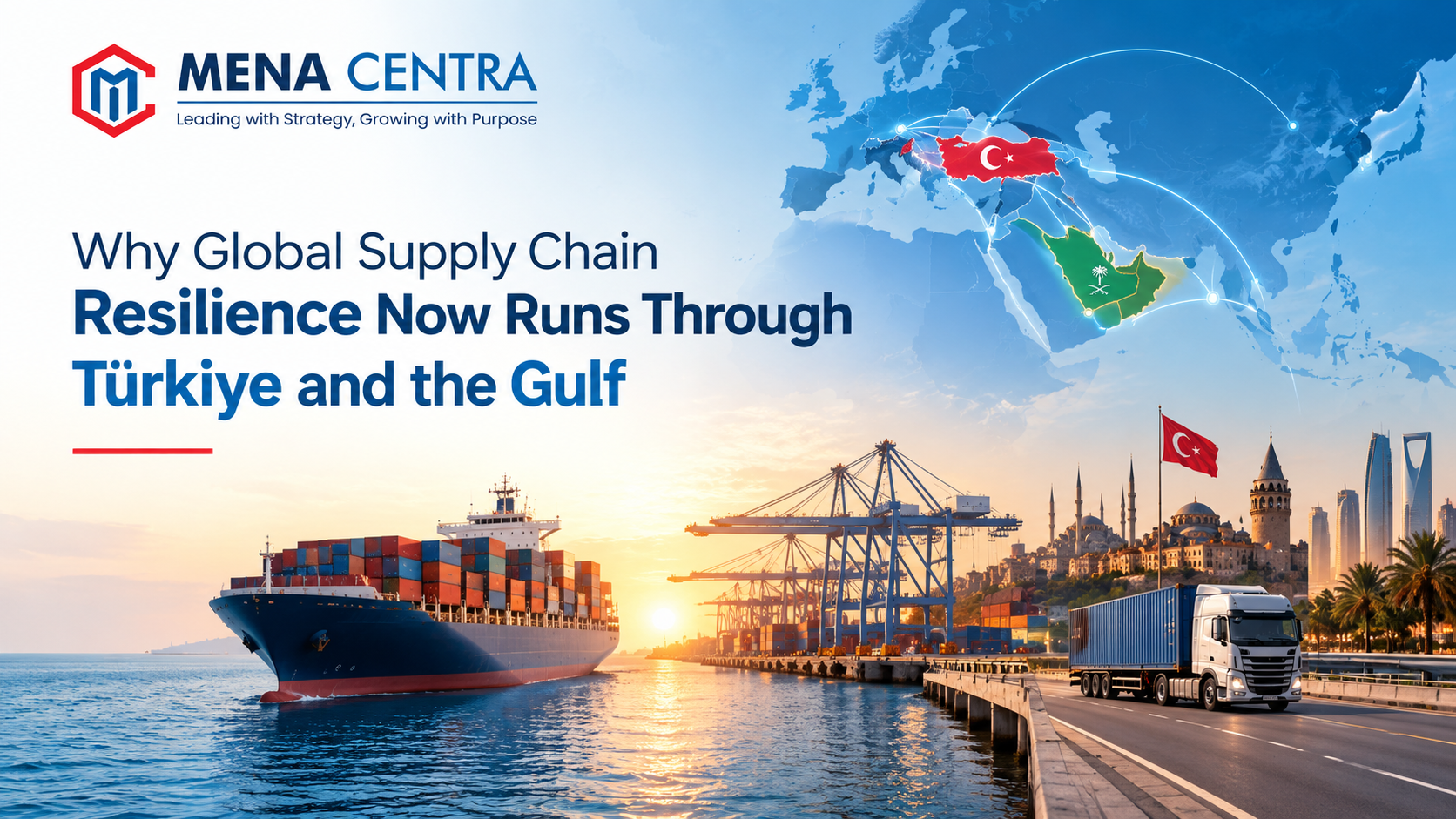
A lot of those answers lead to the same place. The corridor running through Türkiye, the Gulf, North Africa and Europe isn’t new, but it has become a practical option rather than a theoretical one.
Red Sea disruption made that obvious. Ships were sent the long way around Africa, voyages stretched by days and sometimes weeks, and freight and insurance costs climbed with them. Finance teams that rarely thought about geography started thinking about little else. Overland and short-sea routes through Türkiye and the Gulf stopped looking like a plan B and started looking like cover.
Türkiye gets attention partly for its position, but location alone doesn’t win business. The industrial base behind it does. Automotive, textiles, machinery and white goods are all serious sectors there. The country also has a customs union with the EU, ports on several seas, and road and rail links that run straight into the Middle East and the Caucasus.
For a European buyer, that can mean noticeably shorter transit than a long-haul route from Asia. For a Gulf buyer, it means a capable manufacturing partner close enough to call on short notice. That’s what resilience looks like when it’s real. It’s an alternative that already exists and already ships.
The Gulf brings the other half of the picture. Ports in the UAE, Saudi Arabia and Oman move huge volumes, and all three keep building out logistics zones, free trade areas and storage space. Gulf investors are also putting money into infrastructure and industrial partnerships across the wider region.
Put the two together, and you get something more reliable than a single route. Turkish production meets Gulf connectivity and capital, with European and African buyers on either side. A company that understands how those pieces fit can build a global supply chain with genuine backup options instead of one more thin line on a map.
Ask most executives about supply chain risk, and they’ll talk about oceans and mega-ports. Very few talk about the last stretch, and that’s often where things quietly go wrong. A solid local supply chain, meaning reliable domestic suppliers, regional warehousing, and dependable last-mile delivery, is what turns a shipment into a sale.
The better-run companies treat local and global as one system. They keep nearby suppliers warm so there’s someone to call when imports stall, and they place stock close to where customers actually are. A factory in Gaziantep that can redirect its goods to a regional customer in a few days offers more practical value than any presentation promising supply chain diversification.
You can have the best physical corridor in the world and still lose days to paperwork. Customs declarations, certificates of origin, invoices and payment confirmations still move slowly in plenty of trade lanes, and every lost day costs someone money.
This is why cross-border digital trade matters so much now. E-invoicing, digital documentation, live shipment tracking and online trade platforms help businesses catch problems early and reroute before a delay turns into a loss. Governments across the region are heading in the same direction, investing in electronic customs systems and digital trade agreements to simplify cross-border trade and reduce delays between markets.
The firms that adopt these tools early get something surprisingly rare in trade, which is visibility. If you can see where your goods are and what’s holding them up, you can actually do something about it.
Begin by mapping your exposure. Which routes, suppliers and ports do you depend on, and where is there only one option? Be honest about it. Then test an alternative before you’re forced to. A small pilot order through a Turkish supplier or a Gulf logistics hub will tell you more than a stack of reports.
It also helps to build relationships on the ground. Trade across this corridor runs on trust and local knowledge as much as on contracts. Partners who understand the legal and commercial landscape can save an enormous amount of your time when something goes sideways.
The companies that cope best with the next disruption will be the ones that acted before it hit. Türkiye and the Gulf give them a ready platform to do it, with manufacturing depth on one side and connectivity and capital on the other. The global supply chain will keep getting tested. The only real question is whether yours has somewhere else to go.
Ready to build a supply chain that can take a hit? Mena Centra helps businesses structure trade, investment, and partnerships across the Türkiye-MENA corridor. Get in touch and let’s map your next route.