26 October 2026 Admin
Türkiye’s agribusiness sector is emerging as an increasingly important destination for international investment, supported by its diversified agricultural production, established manufacturing capabilities, strategic geographical location, and access to regional and international markets.
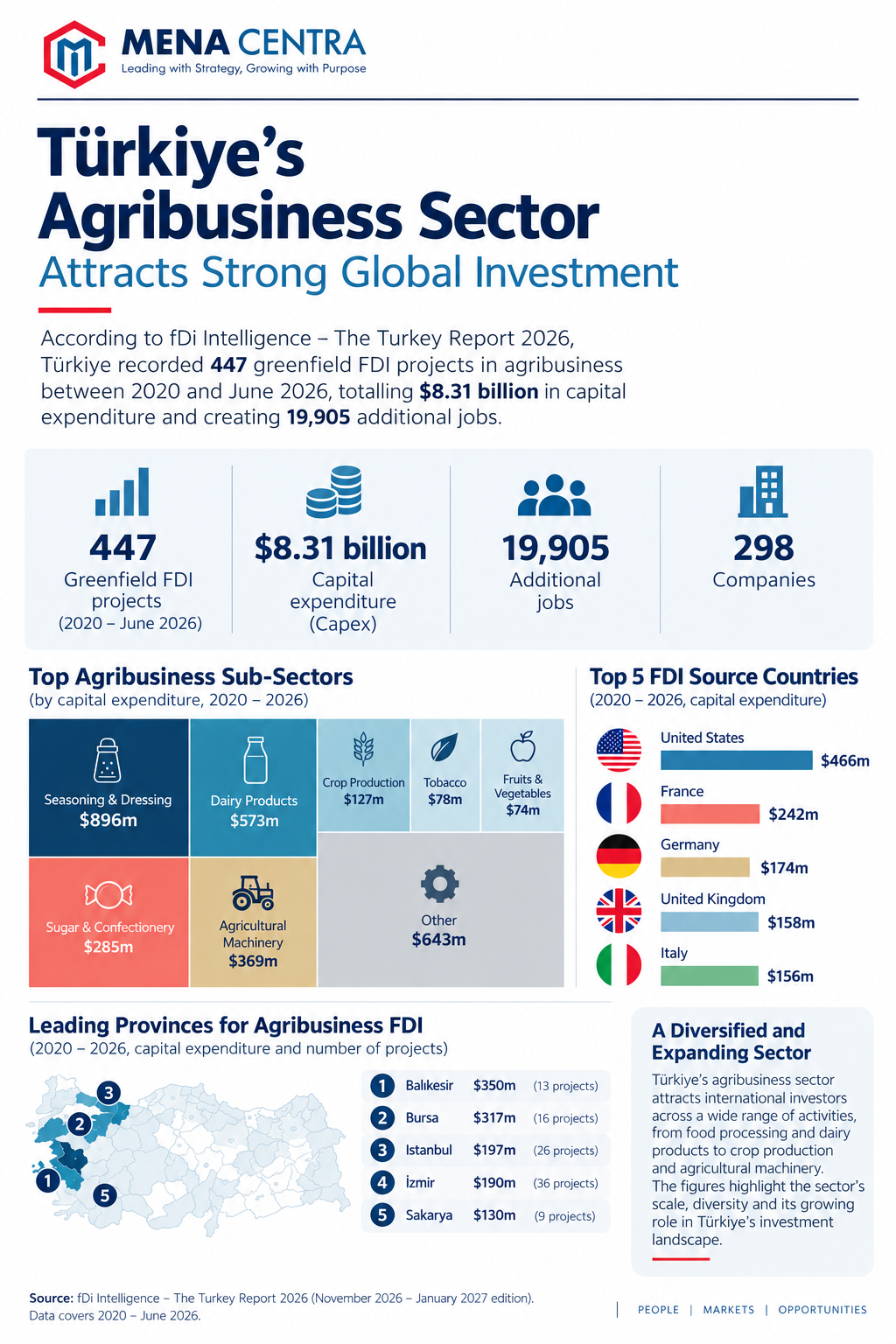
According to The Turkey Report 2026, published on 19 October 2026 by fDi Intelligence, a specialist publication of the Financial Times group, Türkiye attracted 447 greenfield foreign direct investment (FDI) projects in agribusiness between 2020 and June 2026, representing an estimated $8.31 billion in capital expenditure and 19,905 additional jobs.
The findings demonstrate the growing importance of agriculture and food-related industries within Türkiye’s wider investment landscape, extending beyond traditional farming into food processing, dairy production, agricultural machinery, packaging, and other manufacturing activities.
Importantly, greenfield investment data primarily tracks announced projects and associated investment plans. The reported capital expenditure and employment figures should therefore not be interpreted as confirmation that all investments have been fully completed or that all projected jobs have already materialized.
The report was authored by Alex Irwin-Hunt and draws on investment data from fDi Markets, which tracks cross-border greenfield investment projects.
Supported by Invest in Türkiye, the report examines foreign investment across six major industrial clusters:
The agribusiness chapter provides a detailed overview of investment activity across Türkiye’s provinces, highlighting the sector’s industrial diversity and its growing attractiveness to investors from North America, Europe, and Asia.
The report also places Türkiye’s investment performance within a broader economic context, examining the country’s efforts to move towards higher-value production, technological development, and greater integration into international supply chains.
Between 2020 and June 2026, Türkiye’s agribusiness sector recorded:
These figures reflect the scale of international corporate interest in Türkiye’s agricultural and food-processing economy.
The report also identifies 2025 as a record year for the number of greenfield investment projects in the agribusiness cluster, indicating that international investor interest continued to expand despite wider global economic uncertainty.
This performance is particularly relevant given Türkiye’s agricultural production capacity. The report cites United Nations data ranking the country as the world’s sixth-largest agricultural economy by production value in 2024.
However, investment attractiveness increasingly depends on more than agricultural output alone. Processing capacity, product quality, logistics, technology, regulatory compliance, and access to export markets are becoming central factors in international investment decisions.
The report reveals a diversified investment structure, with significant capital directed towards both food-related manufacturing and agricultural technologies.
The largest subsectors by announced capital expenditure include:
These figures illustrate how international investment extends across different stages of the agricultural value chain.
Food processing and dairy manufacturing demonstrate the importance of value-added production, while agricultural machinery investment reflects Türkiye’s established industrial base and the growing relationship between agriculture and manufacturing.
The report also highlights the expansion of international companies producing snacks, sauces, dairy products, tobacco products, and packaging materials.
One example is TürkTraktör, a joint venture involving CNH Industrial and Koç Holding, which has expanded manufacturing operations in Türkiye.
For investors, this diversification suggests opportunities beyond primary agricultural production, particularly in food technology, specialized processing, machinery, packaging, and supply-chain services.
Although Türkiye’s major industrial and commercial centres remain important destinations for foreign investment, agribusiness projects are distributed across several provinces.
According to the report, the five leading provinces by agribusiness investment capital between 2020 and June 2026 were:
An important observation is that investment value does not necessarily correspond to the number of projects.
For example, İzmir recorded more projects than Balıkesir, while Balıkesir attracted a higher total value of announced investment. This difference suggests variation in project scale, industrial activities, and capital intensity.
The report also identifies investment activity in provinces beyond the main western industrial centres, including Giresun, Trabzon, and Şanlıurfa.
This geographical spread is significant because agribusiness investment can support regional economic development, create employment outside major metropolitan areas, and strengthen local production networks.
Nevertheless, attracting investment to a province does not automatically guarantee inclusive local development. The longer-term impact depends on connections with domestic suppliers, employment conditions, technology transfer, and the participation of local producers.
The report identifies the United States, France, Germany, the United Kingdom, and Italy as the five leading source countries for agribusiness greenfield investment by announced capital expenditure.
The United States leads the ranking, followed by France and Germany.
These investment relationships highlight Türkiye’s continued integration into international production networks, particularly those connecting European and North American companies with Turkish manufacturing and agricultural capabilities.
They also demonstrate the role of cross-border partnerships in expanding production capacity and connecting local industries to international markets.
Beyond the five leading countries, the report notes increasing participation by Asian investors in Türkiye’s wider industrial economy.
This diversification of investment sources may provide opportunities for new technologies, alternative supply chains, and broader commercial cooperation.
Several structural factors help explain Türkiye’s attractiveness to agribusiness investors.
First, its geographical position provides access to European, Middle Eastern, North African, and Asian markets. This location can support both regional distribution and export-oriented manufacturing.
Second, its diversified agricultural base provides a foundation for food-processing industries, enabling companies to operate across multiple product categories.
Third, its manufacturing capabilities create opportunities to combine agricultural production with industrial technologies, machinery, packaging, and logistics.
Fourth, its established commercial relationships with international investors provide opportunities for joint ventures, supplier development, and industrial expansion.
Türkiye’s 2024–2028 International Direct Investment Strategy also aims to increase the country’s share of global FDI to 1.5% by 2028, with emphasis on higher-quality investments, competitiveness, and integration into global value chains.
For the agribusiness sector, these priorities could encourage investment in more advanced production methods, technology-intensive activities, and higher-value exports.
Despite the positive investment figures, the sector faces several challenges that deserve attention.
Agricultural and food-related industries are particularly sensitive to water availability, climate variability, energy costs, inflation, and supply-chain disruptions.
International investors must also consider changing consumer expectations concerning product quality, food safety, traceability, environmental performance, and responsible sourcing.
For Türkiye, maintaining long-term competitiveness will require continued investment in agricultural innovation, efficient water use, climate resilience, sustainable production, and workforce skills.
The relationship between international companies and local farmers is another important consideration.
Foreign investment can create economic opportunities, but its developmental value depends partly on whether smaller producers and local enterprises can participate in expanding supply chains.
This makes inclusive business models, fair commercial relationships, and knowledge transfer important dimensions of future agribusiness development.
The findings of The Turkey Report 2026 suggest that Türkiye’s agribusiness sector is developing into a diversified investment ecosystem combining agriculture, manufacturing, technology, and international commerce.
For businesses and investors operating between Türkiye and the Middle East and North Africa, this creates potential opportunities in food processing, agricultural technologies, specialized production, sustainable packaging, and regional distribution.
However, investment figures alone do not determine long-term economic success.
The next stage of development will depend on the quality of investments, their contribution to local economic activity, their environmental sustainability, and their ability to strengthen relationships between international investors and domestic producers.
For MENA CENTRA, the report reinforces an important principle: successful investment is not about attracting capital, but about connecting markets, developing productive partnerships, and creating sustainable economic value.
Türkiye’s agribusiness performance illustrates the potential of a sector that combines traditional agricultural strengths with modern manufacturing capabilities and international investment.
The challenge and opportunity will be to translate this momentum into sustainable growth, technological advancement, and broader economic benefits.
Editorial note: This article is an independent analysis prepared by MENA CENTRA based on publicly reported findings. Investment figures refer to tracked greenfield investment announcements and associated estimates, rather than necessarily completed investment expenditure.